
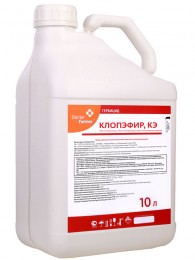
| Eligible crops: | Cereal crops, Corn |
| Application: | Herbicides |
| Harmful sites: | Annual and some perennial dicotyledonous weeds |
| Active materials: | 2,4-D acid in the form of complex 2-ethylhexyl ether + clopyralid in the form of complex 2-ethylhexyl ether |
| Concentration: | 410 g/l (2,4-D acid) + 40 g/l (clopyralid) |
| Chemical family: | Aryloxyalcabcarbonic + pyridine carboxylic acids |
| Formulation: | Emulsion concentrate, EC |
| Packing: | Canister, 10 l |
| Crop | Pest | Application rate, l/ha |
Application rate of working fluid, l/ha |
Application method and time |
|---|---|---|---|---|
| Winter and spring cereals (except oats) | Annual and some perennial (including field thistle) dicotyledonous weeds |
0.6-0.8 | 200-300 | Spray crops during the tillering phase and early weed growth phases. Winter crops are treated in the spring. |
| Corn | 0.7-0.9 | Spray crops during the 3-4 leaf stage and early weed growth phases. |
v An indispensable herbicide for controlling hard-to-eradicate perennial broadleaf weeds, including Euphorbia vinifera.
v Destroys not only the above-ground parts, but also the root system of weeds, providing a protective effect throughout the growing season.
v Due to its essential form, it quickly penetrates into the tissues of weeds, so rainfall 1-1.5 hours after treatment does not affect the biological efficiency.
Mechanism of Action
The ester forms of 2,4-D acid and clopyralid are synthetic analogues of plant growth hormones. Once in the plant, they are quickly redistributed (through the xylem and phloem) and replace natural plant hormones, thereby blocking their functions. In this case, oversaturation with synthetic hormones occurs, which leads to disruptions in the processes of photosynthesis and cell division, causing abnormal deformation of the leaves, Significant disruption of weed growth and subsequent death.
Symptoms of Effect
The main symptoms of effect are: uneven growth of above-ground organs, various types of deformation, leaf discoloration, shortening of internodes, reddening of veins, leaf chlorosis, death of growth points, tissue necrosis.
Speed of action
The first signs of herbicidal action, under favorable weather conditions, appear on sensitive weeds as curvatures and chlorosis, 1-2 days after application.
Active weed growth ceases within the first 24 hours after spraying. Complete destruction of weeds occurs within 14-20 days after application.
Spectrum of action
Susceptible weeds: Hemlock grass, Common ragweed, Radiant biphora, Common thistle, Spotted hemlock, Blue cornflower, Common vetch, Common gromwell, Crow's foot, Knotweed (species), Field mustard, Tatarian buckwheat, Common cocklebur, Common datura, Common chickweed, Common hemp, Stinging nettle, Common ragwort, Common ragwort, Velcro (species), Burdock (species), Common toadflax, Vine spurge, Common winter cress.
Medium-sensitive: Speedwell, Field Bindweed, Galinsoga (species), Geranium Tender, Geranium Dissecta, Hibiscus Ternatea, Pea, Mouse Pea, tall rhododendron, distichium (species), common sweet clover, rhododendron, fumitory, fulvous fern, common bugleweed, commelina, common cockle, spreading orach, field buttercup, black nightshade, sedge (species), plantain (species), wormwood, white campion, field violet.
Period of protective action
It does not have a soil effect, it affects only the weeds that were present at the time of treatment. If the recommendations are followed, one treatment is sufficient to effectively suppress dicotyledonous weeds until the end of the growing season, provided that the crop develops optimally.
Recommendations for use
The product is most effective when applied to actively growing weeds in the temperature range from +8°C to +25°С.
Larger
We will contact you shortly.